Key Findings
Land ownership & control
1. Restricted land ownership and control
- Story Transforming Land Ownership and Control through Community Woodlands
- Aim Strengthen community land control
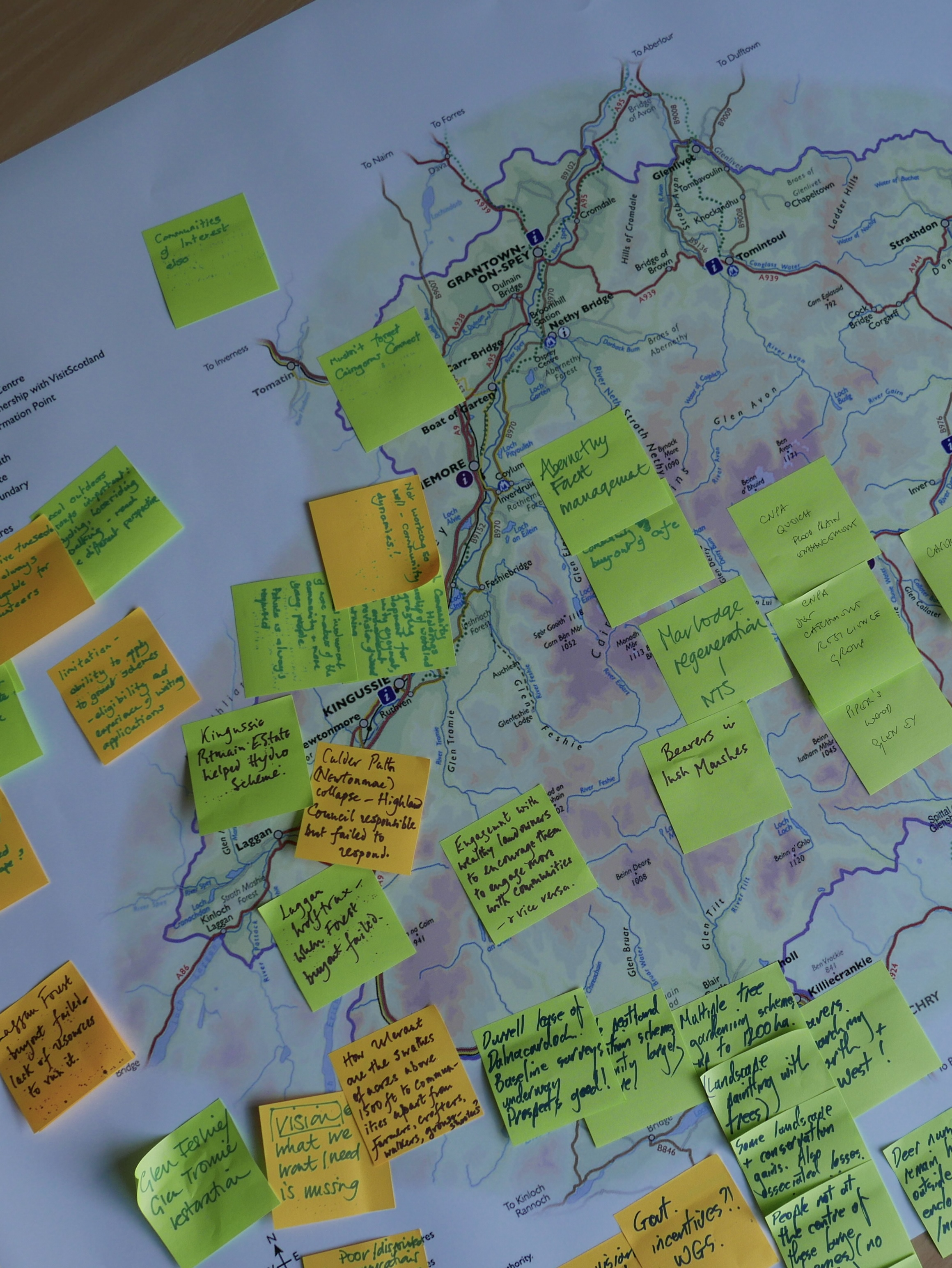
- Map See this theme on the map
‘Unless a bit of land comes available, nobody feels empowered, really, to do anything. Or they don't see an opportunity because there's no access to the land’.
Land ownership and control are key factors in facilitating community-based landscape regeneration, as our research highlights. In the Scottish Highlands, a small number of private and organisation-based landowners own and control vast swaths of land. By contrast, community-based organisations and groups own areas of land including community woodlands and green spaces, alongside land that is managed by communities under lease or partnership arrangements. For communities engaging with landscape regeneration, land ownership structures are central to challenges of gaining land access and of having control over land. This is particularly important in Scotland given the histories and legacies of the Highland Clearances and the romanticisation of ‘empty’ and ‘wild’ Highland landscapes over the centuries.Martin et al., ‘Taming Rewilding’.
With the rollout of land reform policies and measures in Scotland over the past two decades, notably through the Community Right to Buy scheme and the Community Asset Transfer Scheme (CATS) alongside funding channels, some opportunities have opened up for communities to acquire land and contribute to landscape regeneration practices. While these have facilitated steady increases in the numbers of community-owned land and assets since 2000,Scottish Government, Community Ownership in Scotland 2024. particularly in rural areas, land inequalities in Scotland have continued to worsen,Wightman, Who Owns Scotland 2024. and communities continue to face substantial barriers in acquiring and accessing land. There are ongoing tensions between policy commitments, on the one hand, to empower communities and create a fairer land system and, on the other hand, to incentivise natural capital and ‘green’ private investments in Scotland’s rural land. Further developments on land reform are continuing with the passing of the recent Land Reform (Scotland) Act 2025.
Our research highlights several examples of community organisations in the Cairngorms undertaking small-scale landscape regeneration practices. Although robust evidence of outcomes is lacking, many examples of community land acquisitions across Scotland show a shift in approaches, away from private estates managing land for sporting or commercial forestry toward land management tied to nature recovery, biodiversity and climate outcomes.Lawrence and Macaulay, Intersections Between Land Reform and Rewilding in Britain. Our findings highlight the importance of strengthening people’s connections to land and nature, and possibilities of what could be done with the land and of ‘re-peopling’ rural areas to halt population decline as people move to urban centres. In the stories below, we discuss examples of how community ownership has contributed to transformations in land-based livelihoods and ways of realising community wealth and benefits.
Social, ecological & economic benefits
2. Landscape regeneration and socio-economic benefits
- Story Generating Social and Economic Benefits from Landscape Regeneration
- Aim Align social, ecological, and economic benefits within landscape-regeneration initiatives
- Map See this theme on the map
‘You know, [they] see themselves as custodians of the land and wouldn't ever want to shout about what they do or what they have done, and what they have done for a long, long time as well before anyone else came in to speak to them about it. Have you thought of doing this for the land? And they're like, we've always been doing that…’
With nature restoration and land reform initiatives underway, rural land uses and livelihoods in the Cairngorms and Scotland are set to significantly alter over the coming years. There are challenges to ensuring just transitions of land, including supporting the economic revitalisation of rural communities, community wealth-building, the fair distribution of community benefits and the development of opportunities for decent jobs in landscape regeneration.
Our findings emphasise the importance of integrating economic revitalisation with landscape regeneration efforts. Community engagement in landscape regeneration is closely tied to job creation, affordable housing, public services, transport, and local governance. Such issues are particularly pronounced in relation to calls for re-peopling of the landscape. Without affordable housing, transport, and childcare in the area, the staffing of green jobs can be constrained. Housing costs in rural Scotland are rising, exacerbated by the growing number of second homes, while jobs, particularly for young people, can often be low-paid, seasonal, and precarious. These factors result in depopulation and ageing populations as young people leave the area in search of job opportunities. Research participants noted that these key socio-economic issues need to be addressed alongside initiatives for communities to engage in nature restoration.
Landscape regeneration is not a singular objective; rather, it connects to the revival of land-based livelihoods. Indeed, many research participants expressed a hope that green jobs will expand in rural Scotland. Some existing livelihoods, particularly traditional industries and land uses such as farming, will need to be carefully and fairly managed as part of a just transition. Our research highlights the importance of rural skills development to support the development of sectors linked to landscape regeneration, such as forestry. In the stories below, we show how communities have developed initiatives to realise collective benefit and skills through emerging land-based livelihoods.
Community capacities
3. Unequal community capacities
- Story Building Community Capacities through Community Development
- Aim Expand community capacities through networks, education, and resource sharing
- Map See this theme on the map
'…there's some seriously capable skills embedded in communities where there might not have been once before where they were all going to urban areas to work’
Communities vary significantly in their ability to design, develop, and carry out regeneration plans and practices. These differences are based on a number of factors, including resources, funding, support, knowledge, skills, population size, and community cohesiveness. Community capacities are unequally distributed across the Cairngorms, structuring whether and how communities can initiate and respond to landscape regeneration opportunities. While some communities struggle to undertake project development or realise positive impacts, other communities are in a more advantageous position to draw on a wide range of skills and expertise, impactful supporting networks, and access to funding and other resources. This disparity in community capacities tends to run along socio-economic lines, with less well-off and deprived areas more likely to lack resources and capacities (e.g., people with free time or professional expertise in finance and contracts) to develop and run community-based organisations or community-led initiatives. There is potential for these disparities to further exacerbate social inequalities across rural Scotland.Sharma, ‘In Danger of Co-option’. The diversity of communities and capacities is described in more detail in the stories section that follows.
Nevertheless, even the most well-connected and skilled community initiatives encounter recurring problems with staffing and volunteer availability, limited resources and funding, which multiple initiatives compete for, constrained project longevity without ongoing resources and personnel, and changing opportunities and networks due to the precarity of many of these initiatives. Research participants identified that one important way to address constrained capacities and limited resources in the Cairngorms is through knowledge exchange, collaboration, and network-building. Communities can build skills and expertise by learning from each other, including from those who run more experienced, long-standing community initiatives. In doing so, community groups could achieve landscape-scale impact through regional partnerships and network-building. In the stories below, we provide examples of how communities have engaged in capacity-building within and across landscape regeneration networks and initiatives.
Community voice & engagement
4. Limited community voice and influence
- Story Strengthening Community Engagement and Influence
- Aim Enhance community engagement in land-use decision-making
- Map See this theme on the map
'What people need is power, not more engagement’
Although there are growing calls for people-centred approaches to nature restoration, our research highlights that communities often feel disempowered from land-based decision-making. This lack of community influence occurs in landscapes across different scales. With significant tracts of land controlled by large-scale landholding organisations and private landowners, communities in Scotland continue to feel disempowered to influence land-based decision-making, whether this concerns farmland, sporting estates or restoration initiatives.
Mechanisms for communities to engage in and to be heard tend to be poorly developed. Our findings show growing criticism of the lack of community engagement and democratic tendencies of some restoration initiatives. However, while perhaps better embedded locally over a longer period, the older, more traditional estates can rely on familiarity and complacency, thereby overlooking the importance of ongoing community involvement. Without robust, well-developed mechanisms in place, it falls to individual landowners and land managers to mobilise community engagement. As a result, the quality of community engagement across different landowners varies considerably, reflecting varying values, commitments, and resources.
Our findings show that communities call for large landowners not only to engage but also to act on community input. Such efforts could give communities a stronger voice in land-based decision-making. We highlight examples below, both in the toolkit review and in the landscape regeneration stories, where community engagement in land-use decision-making and community-based initiatives contribute to greater community voice and influence. We show how small projects that are effectively connected to wider contexts and institutions can help to realise outsized impacts, even with limited land and resources.
Democratic & ecological renewal
5. Diminished local governance and democratic participation
- Story Linking Democratic Renewal with Ecological Renewal
- Aim Integrate democratic renewal with ecological renewal
- Map See this theme on the map
'There is a governance gap, from national to local’
During our interviews, workshops and site visits, research participants noted that some aspects of Scottish governance can constrain and negatively affect communities attempting to engage in and benefit from landscape regeneration initiatives. Overall, participants frequently mentioned a lack of robust local and municipal structures. Local authorities operate at the regional level, covering vast areas and many communities, creating a gap between local and regional governance. Local authorities, such as the Highland Council, are not seen to be representative of local areas or grounded in local priorities. Community councils are the local representative bodies for residents, yet they are under-resourced. They also have little formal input into higher-up decisions about the land.
Further constraints relate to public-sector planning and bureaucracy, as well as community efforts to obtain funding or support for their initiatives, or to engage in and provide input on local developments. Many participants observed that communities are not central to the planning system, and their contributions to consultations are not adequately recognised. This disconnection can contribute to community distrust of planning processes. Participants also identified a lack of joined-up thinking in the public sector and silos across different public bodies. This means, for example, that there is sometimes limited clarity about application channels for funding or asset transfers, requiring a high level of knowledge of the policy landscape and further straining community capacities.
Our findings show there is a widely noted imperative to rebuild local democracy and establish a robust system of local government in Scotland, thereby addressing the democratic deficit between community and council levels. This could help to address the lack of meaningful community involvement in landscape regeneration, which suffers from minimal democratic input from rural communities. There are calls for greater community input into National Park plans, projects, and developments as part of deliberative, democratic processes at the local level. In the sections below, we discuss examples of how democratic renewal can be combined with ecological renewal through projects that transform and advance local governance within landscape regeneration initiatives.